Shabbat Services
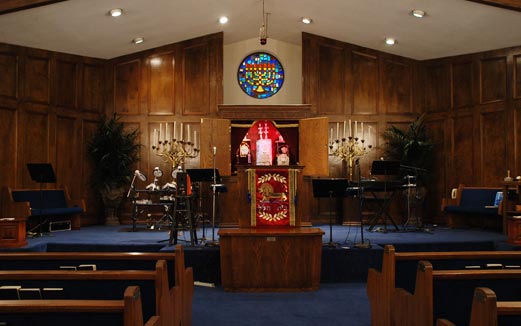 In our services, we combine traditional Jewish liturgy with a mix of Scripturally-based, contemporary Jewish music that helps lead people into an enhanced worship experience. You will see physical forms of worship such as clapping (Psalm 47:1) and lifting our hands in surrender to Adonai (Psalm 63:5) which are all a part of good old fashioned Jewish celebrative praise (Psalm 150).
You will notice that a portion of our service is done in Hebrew. This is the language of our people, and the original language of the Bible. If you are a newcomer to this, don’t be alarmed! You don’t have to be a Hebrew scholar to worship with us. However, if you listen carefully, you will find that almost everything in Hebrew is immediately repeated in English, or provided in a translated form in our siddurim (prayer books). Our service leaders explain most everything that we do so that our visitors can understand and comfortably take part in the many traditions that are part of our services.
A custom you may already be familiar with is that of men wearing tallit (a fringed prayer shawl). The Biblical reference for “fringes” is found in B’midbar (Numbers) 15:37-41, where Adonai uses it as a focal point to remind His people to obey Him and not to follow their own impulses which could lead them astray. It also represents G-d’s desire to have the royal thread of His presence interwoven throughout every fiber of our lives.
Although there is no biblical reference to today’s kippa or yarmulke (skullcap) worn by Jewish men, there are references to head coverings being worn by the Cohanim (Levitical Priesthood). Traditionally though, the kippa represents a deep desire to humbly submit oneself to the headship of Adonai. It has been a symbol of Jewish identity for at least the past several hundred years and serves as an outward sign of respect for the house of G-d. No one is forced to wear a tallit or a kippa; however, we do have some in the lobby that visiting men can wear during the service, if they choose.
Following the portion of the service dedicated to liturgy, music and the Torah service (a special time when we read an assigned portion from the Torah, the Haftorah and the B’rit Chadasha (New Covenant)), our Rabbi teaches Scripture and how it applies to our lives. These relevant messages are insightful, challenging and clearly communicated, helping the congregation to strengthen their relationships with the G-d of Abraham, Isaac and Jacob.
We have fantastic classes for our yeladim (children) during our Shabbat services, too. See the table below for details.
After the service ends, all members and visitors are invited to an Oneg Shabbat (joy of Sabbath in Hebrew) where they can socialize together and enjoy bagels and cream cheese served by members of our Sisterhood. Our gift shop and library are open during this time, as well.
What Is Available For Children During Shabbat Services?
For more information about our Children’s Education department, contact us at edu@bethhallel.org.